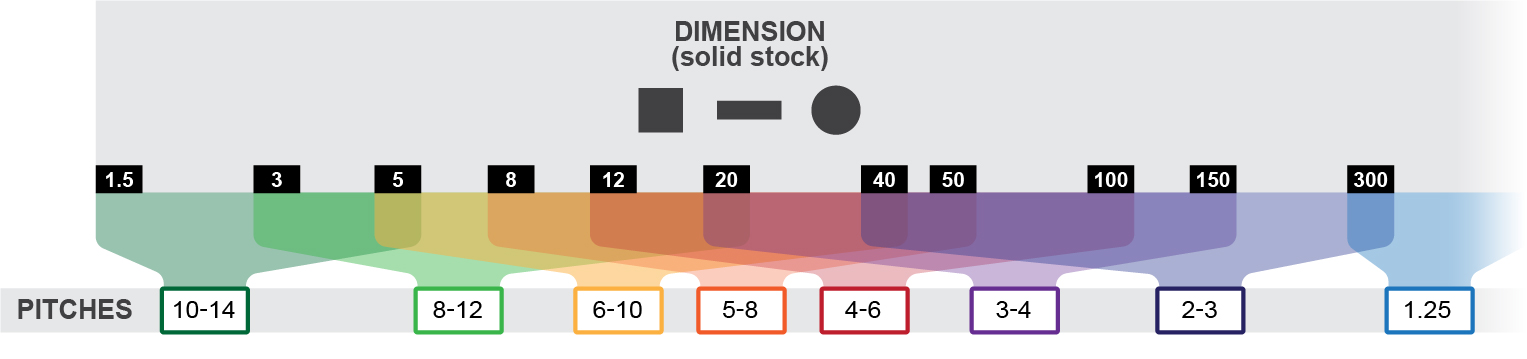
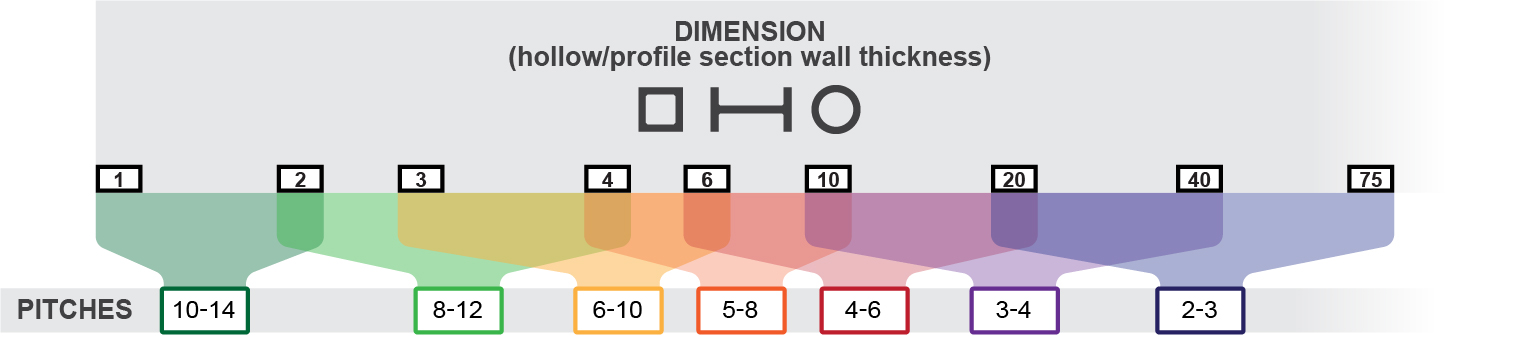
This quick-reference tool will help you see which blade pitches will cover the range of sizes you’re looking to cut (or let you know that the range is too broad to be covered by just one pitch option).

Example
Cutting Requirements:
A broad range of both solid and hollow sections is to be cut and the ideal outcome is to have one pitch option suitable for the whole range.
- Solid sections:- From 18mm to 50mm, with 80% or more being over 30mm.
- Hollow/profile sections:- The minimum wall thickness is 4mm, the maximum is 18mm. Only a very small portion of the work is made up of wall thicknesses below 5.5mm.
Recommendation
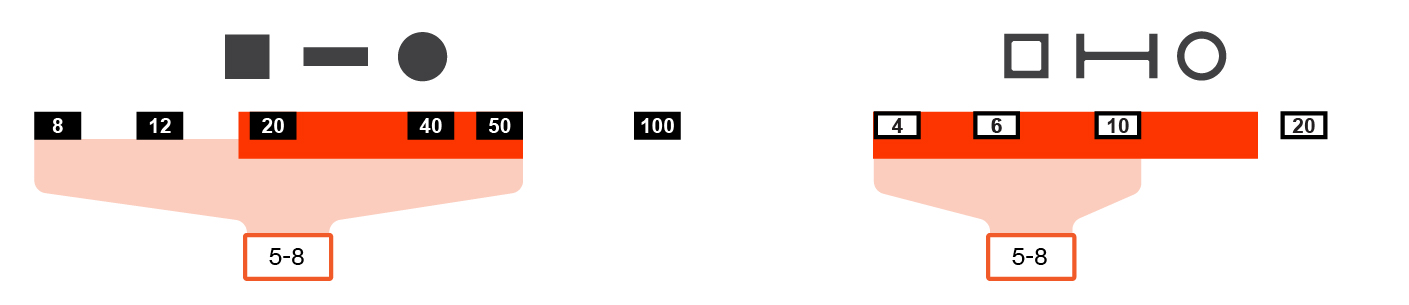
The range of solid sections can be covered by the optimum range of a single pitch selection, that being 5-8tpi.
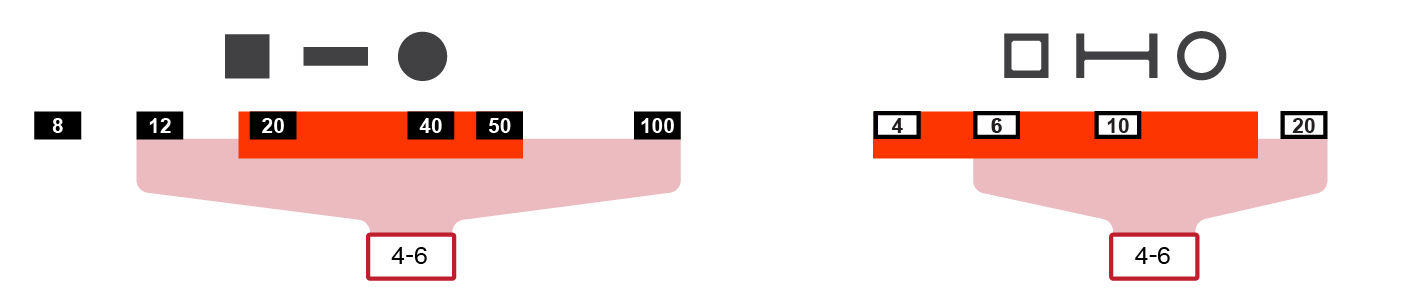
Looking at the hollow/profile sections, the range is not covered by any single pitch option. At its finer end, 5-8tpi will cover from 4mm to 10mm but the heavier sections up to 18mm fall outside the optimal range for that pitch. Also, the 4-6tpi option covers the heavier end but wall thicknesses of less than 6mm are outside the blade's optimal range.
The chart above provides a visual overview of the range of dimensions considered optimal for each pitch selection.
It shows that the 5-8tpi option would cover the range of solid materials well but the heavier hollow/profile sections would fall some way outside the optimal range for the blade.
Choosing a 4-6tpi blade will put all of the solid sections inside the optimal range.
It would also cover most of the hollow/profile sections required as well, only those with wall thicknesses of less than 6mm being suboptimal.
Conclusion
Considering that almost all the hollow/profile sections would have walls of at least 5.5mm and that most of the solid sections are greater than 30mm, the 4-6tpi is likely to be the best compromise in this example.